Original article in translation · calculations from March 2014
Sooner or later someone asks me: what is the cheapest way to heat a building?
Could a heat pump be cheaper? Or firewood? Or pellets? Solar panels?
Every now and then a miracle device appears, such as a cavitation heat generator promising impossibly high efficiencies. In short, even I sometimes find it difficult to make sense of the torrent of information produced by marketing nonsense generators.
But there is a relatively simple explanation for everything. It will be more simple than complicated, and given that heating, ventilation and air conditioning can account for up to 80% of a property’s operating costs, it is worth understanding.
The most important decision in minimizing operating costs is choosing the cheapest fuel. At the time of writing (19 March 2014), natural gas was the cheapest.
For households (meaning customers in the “residential” tariff category of Ukraine’s energy regulator), there was virtually no alternative to natural gas, except, for example, in parts of Donetsk region where miners received a certain quantity of coal free for heating their houses. Or perhaps you and a neighbour might go into a nearby forest at weekends as part of your healthy lifestyle and cut down a couple of dead trees for firewood. Households had only one reasonably competitive heat source, and it was not suitable in every case: an ordinary air conditioner with a heating function. As my calculation in 2010 showed, after another gas tariff increase on 13 July 2010, heating with an air conditioner cost 30% less than gas in the second consumption tier (UAH 1.10/m³) and was comparable to the first tier. This allowed people consuming more than 2,501 m³ of natural gas per year to move into a lower consumption tier, reducing gas consumption for comparable electricity expenditure and also paying less per cubic metre for gas — a double saving.
Later, a threefold tariff was introduced for electricity consumption above 800 kWh per month, almost eliminating the potential savings from using an air conditioner for heating.
Still later, with some contribution from one of my heat-pump-manufacturing partners, a new regulation introducing a seasonal tariff under clauses 1.4 and 1.5 was substantiated and adopted. It allowed up to 3,600 kWh of electricity to be used for an air conditioner or heat pump from 1 October to 30 April at the reduced rate of UAH 0.21/kWh. The only complication was having to prove to the regional electricity utility that the home had been equipped with electric heating installations.
As you can see, circumstances kept changing, so the economics of installing a heat pump or a cooling-and-heating air conditioner had to be calculated for each household’s specific annual natural gas consumption.
For commercial businesses and non-residential buildings the fuel choice was much less clear-cut. They had no consumption tiers, but the price of gas was tied to the cost of gas imported from Russia. Where relations with Russia would take us was difficult to predict. One thing was clear at that moment: the gas price reduction for commercial enterprises that Yanukovych had planned for 2014 would not take place. Even though VAT on gas imports was abolished on 16 January 2014, the abolition was itself cancelled on 28 January. These fluctuations created price uncertainty — first for political reasons, and second because the dollar exchange rate had risen by 25%, which would soon be reflected in the tariff.
At that time the price was calculated under an approved methodology and consisted of:
- the price of imported gas;
- 20% VAT;
- a 2% earmarked surcharge;
- transportation costs, differing by regional gas utility, approximately UAH 300 per 1,000 m³.
Combined, those components yielded a price of approximately UAH 4.20 per m³ of gas (Kyivgaz, Donetsk city gas utility).
That price was not particularly high relative to other fuels. But did it make sense to depend on politics and currency fluctuations in such unpredictable times? No wonder many business owners were considering coal, firewood and pellets as their main fuels. Modern solid-fuel boilers were relatively automated and economical, and with good-quality fuel did not need frequent cleaning. Nevertheless, they definitely required an operator: unlike a gas boiler, a solid-fuel boiler could not be left unattended without periodic refuelling.
Below is a table comparing the cost of producing heat from different fuels for commercial enterprises:
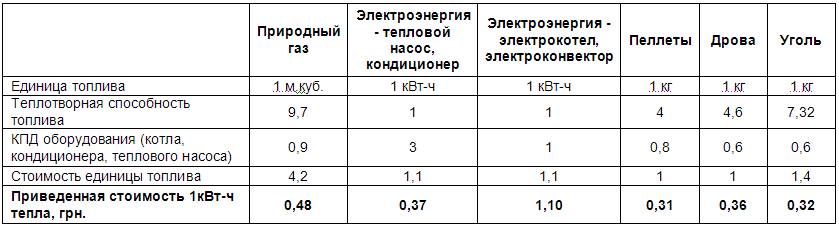
So if your business only needed to heat 100–200 m² of premises, paying a boiler operator was unlikely to be economically worthwhile.
But where the boiler plant capacity exceeded 50 kW, the advantage would be clearly felt.
Moreover, there had recently been a tendency to inflate the connection costs for both gas and electricity networks. We certainly could not leave a building without electricity, but gas was another matter. One of my clients was quoted such a high gas connection fee that my calculations showed the amount spent on permits and approvals alone would have bought enough firewood to heat the premises for 30 months with a daily outdoor temperature of −22°C. Under such conditions, connecting to gas was simply unacceptable.
All of these factors influence the choice of heating fuel. Unfortunately, the uncertainty of our times makes it impossible to offer recommendations very far into the future. But an engineering approach always lets us update the figures and assumptions and make sense of the situation.
Historical tariffs, legal references and economic estimates are preserved for accuracy and are not current recommendations.
Original Russian article · Full article series
All articles in the series
- What Is Energy Conservation? An Engineering Approach
- Energy Conservation: General Principles and the Creative Process
- Justifying the Need: Do We Need Energy Before We Can Save It?
- Reducing Heat Losses
- Managing Heating Systems
- Which Is Cheaper for Heating: Gas or Electricity?
- Saving Gas: Where Should You Start?
- Energy-Saving Windows
- Energy saving in residential buildings (2014 original in Russian)

